How Multi-Agent Systems Are Transforming POS Systems in Modern Businesses
Discover how Multi-Agent Systems enhance POS software with smarter inventory tracking, sales insights, workflow automation, and improved business efficiency.
Introduction
However, the modern company requires more than an accounting and receipt generation system. It requires technology that would assist in inventory control, understanding of customer behavior, reducing repetitive tasks, and making informed decisions. All of these are especially crucial for retailers, supermarkets, restaurants, and other companies that process sales on a daily basis.
Traditional point‑of‑sale. Pos systems, support billing, payment processing, product management and sales reporting. However when a business grows, managing these activities across tools can become slow and tiring.
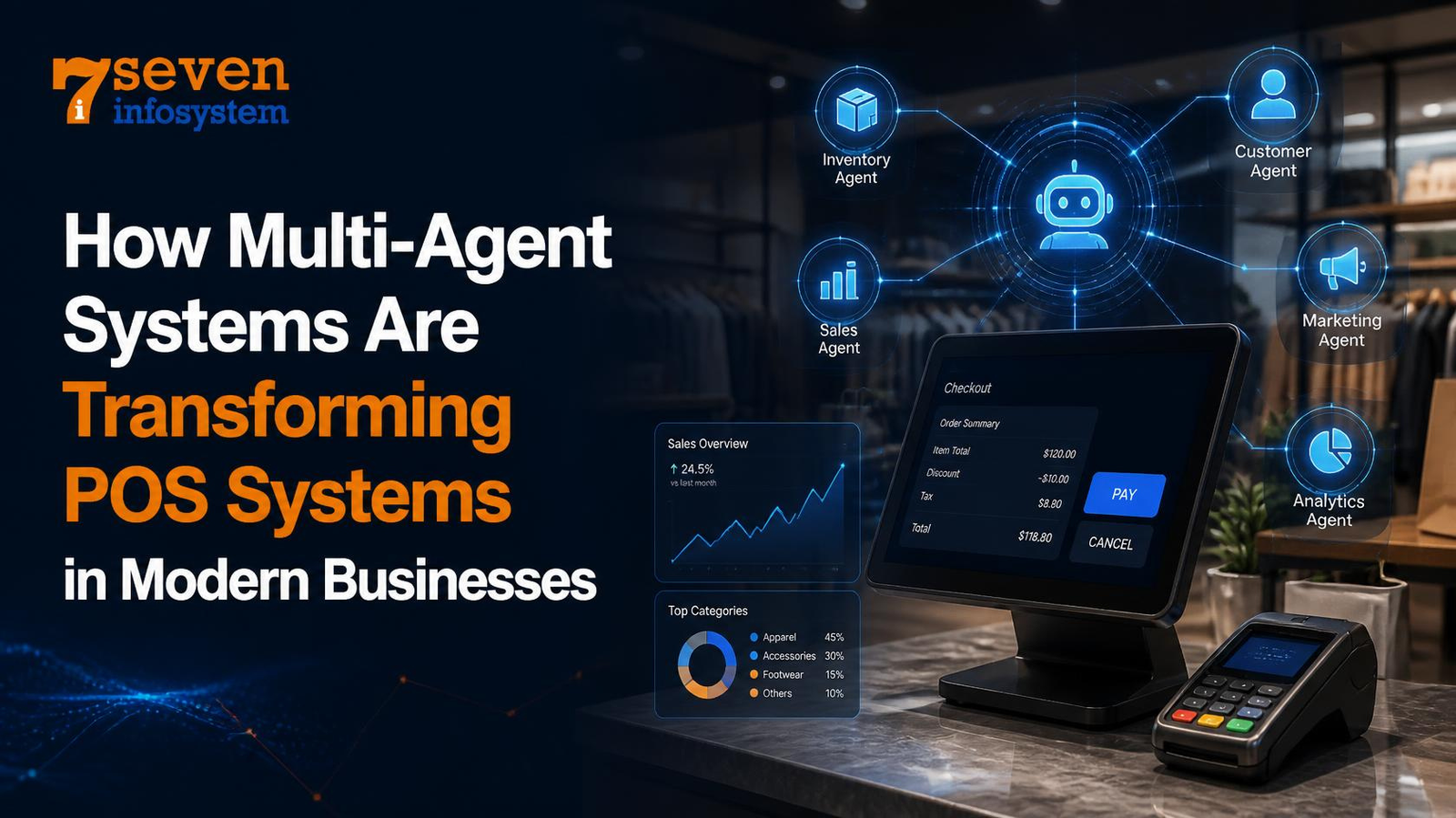
Multi-Agent Systems can help enhance POS performance. With the help of specialized AI agents, companies would be able to automate their workflow and have access to valuable information. For instance, one agent could analyze sales data, another one – control the inventory, and the last one – generate business reports.
As part of the digital transformation, this concept can be used to link software and intelligent automation. Under appropriate conditions of security and permissions, such systems could be quite helpful for the business.
What is a POS System?
A Point of Sale (POS) system is a computerized technology made up of software and hardware tools which are used by businesses to carry out sales, payment processing, managing inventory, and transaction tracking. POS helps in processing payment bills and organizing vital data related to sales within one system.
A POS system today is not only limited to billing functions. It depends on the type of software installed whether there will be added capabilities like inventory management, customer information, employee access controls, sales reporting and integration with accountancy or e-commerce software.
It is most common for POS to be used in stores, supermarkets, restaurants, cafes, and services companies.
What Are Multi-Agent Systems, and How Do They Work in POS Software?
Multi-Agent Systems are the software environment where several independent agents perform tasks, analyze information or make suggestions in order to achieve certain goals. The agents can be programmed to do one specific task within a certain scope. Depending on the architecture, the agents are able to exchange information and collaborate in order to execute more complicated workflows.
In a POS software environment, such agents can function together with existing software without completely replacing the software.
For instance, the retailer can use different agents for analyzing the sales, monitoring the inventory, providing customer support and generating reports. When a sale occurs, the POS software records the transaction. An inventory agent will be able to analyze the updated stock level, while the reporting agent will use the transaction data to update the business reports.
In order to provide digital transformation services, companies are able to add AI agents into their POS systems but keep certain critical processes like payments authorizations and transaction records under control of the reliable POS software.
Understanding the Role of Individual Agents
I think every agent should have a responsibility. That makes the system easier to maintain, to monitor and to improve.
For example think about a clothing store that sells items in outlets and on an online shop. The store’s POS software may already record sales. Employees still spend time checking stock finding out which products are popular and preparing reports.
A multi-agent setup could split these activities into tasks:
Sales analysis agent: reviews sales data and finds patterns in product demand.
Inventory agent: monitors stock information and flags products that may need restocking.
Customer assistance agent: helps staff find product information or answer routine questions.
Reporting agent: prepares summaries of sales, inventory changes and how the store performs.
Workflow coordination agent: organizes communication between agents and checks if tasks meet predefined conditions.
Agent independence can make its task-specific decisions, within authorized limits. However agent independence does not mean access. Business rules, access permissions and approval requirements should decide what each agent can do.
How Agents Work Together
The key value, however, lies in integrating tasks rather than incorporating a number of AI elements into the POS software.
For example, a store may detect that one of its best-selling products is going out of stock quicker than was expected. This particular information will be picked up by the sales analysis agent and communicated to the inventory agent, which will evaluate the stock and recent sales and alert the management of the potential shortage of inventory. The reporting agent will summarize the situation and communicate it to the store manager.
Depending on the inventory management policies set by the company, the system may automatically generate a replenishment request. In such a case, the order will still be approved by a person, especially in case of large orders that require considerable spending.
In this manner, it will be possible to save employees' time needed to gather information on multiple interfaces and spreadsheets, and provide management with a better overview of the situation.
The exact things the agents can do depend on the quality of the data, the connections that're available and the rules that each agent follows. Multi-agent technology works best when it solves a business problem instead of making things more complicated without a real reason.
Key Benefits of Multi-Agent Systems for Modern POS Operations
Organizations use innovations in order to resolve problems. As far as POS management is concerned, the greatest improvements are related to the reduction of routine activities, facilitation of information access, and faster reaction of employees to the problems.
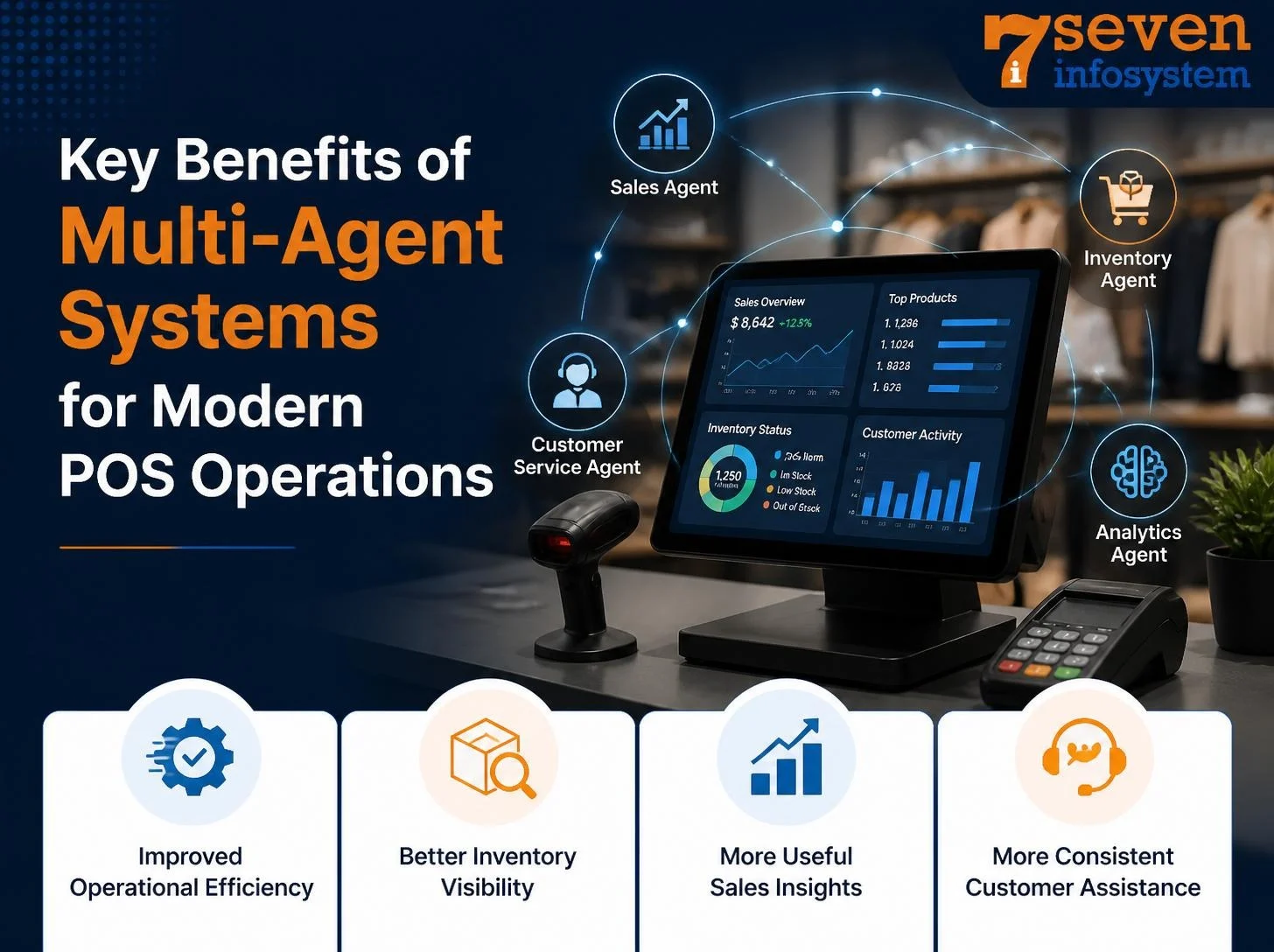
1. Improved Operational Efficiency
Employees of retail organizations often carry out repetitive actions including verification of the inventory, report compilation, analysis of sales statistics, and tracking of the shortage of certain products.
The multi-agent system allows coordinating these actions. One of the agents can track certain products, while the other compiles a report of sales and inventory statistics. Employees will be able to evaluate the outcome without collecting data from different sources.
It will allow automated business operations and spending of employees' time on assistance to customers and maintenance of the display.
The idea is not to automate all activities. Organizations should find routine activities that can be automated.
2. Better Inventory Visibility
Stock management issues may have an effect on earnings and client experience. For instance, running out of best-selling items could mean loss of potential sales, whereas stocking excessive amounts will lead to higher warehousing expenses and tied up funds.
Using agents with inventory data integrated, one can track the flow of goods and find any peculiarities in demand. Another agent could be responsible for checking the current stock levels against preset limits in the business and pointing out which items need attention.
It is likely to provide additional support for existing inventory management software by making important data clearer to comprehend.
For instance, a restaurant could be notified about increased use of some vital components. It is easy to check if the issue is connected with the rise in demand or a special event and not due to wrong data input.
3. More Useful Sales Insights
POS systems collect information about transactions, product performance and buying habits. However simple sales numbers do not always show what a business needs to do
An analysis agent can spot trends such as products that sell well on weekends, changes in the average amount spent per transaction or differences in demand between store locations.
A reporting agent can put these findings into summaries that managers can look at during weekly planning.
These insights can help make choices about sales promotions, where to place products and how many staff to have. However suggestions should be seen as proof to help with decisions not as predictions. Sales trends can shift because of seasons, prices, local events and other things.
4. More Consistent Customer Assistance
Staff members need access to correct information when customers ask about product availability prices order status or return policies.
With the connections AI agents can help get information from approved business systems and show it in a helpful way. Employees can ask a question in language instead of going through many menus.
For example an employee could ask if a specific product is available at another store. An authorized agent can check the stock records. Share the available details.
Important tasks, like refunds changes to payments or access to customer information should stay safe with permission rules. Companies should also make sure customer answers follow rules and have correct data.
Practical App of Multi-Agent Systems in Retail Businesses
The advantage of the use of multi-agent systems becomes evident when looking at practical examples. It is possible to apply the same methodology but with varying application to various industries, based on their processes.
Supermarkets and Grocery Stores
Supermarkets operate with thousands of products, high transaction volumes, and constant stock movement. The manual monitoring of all these products is not an easy task, especially when it comes to the busiest moments.
The sales agent can determine the products that have increased demand. Then, the inventory agent will analyze these numbers against the existing stocks. Another agent will make a list of products that need to be handled.
The manager of the store will be able to prioritize the products and find out about the possible shortages.
Other agents may provide information about wastage patterns and the products that need additional attention. This becomes helpful when the POS system interacts properly with inventories and purchasing data.
Multi-Store Retail Chains
Organizations having multiple stores need a common understanding of sales, stock, and operations.
Agents could be of assistance in comparing the data at store level and in analyzing differences requiring further investigation. One of the stores might have high sales of certain products, while another one has surplus stocks.
In case the organization has enabled the facility of transferring stocks and its system is capable of doing it, agents could suggest such a move for consideration by the employee.
The system needs to take into consideration stock reservations, transfer costs, delivery time, and demand in the locality before suggesting any change.
E-Commerce and Omnichannel Businesses
Many retailers sell through stores, websites, marketplaces and mobile apps. When these channels use systems employees may struggle to keep product availability and order details consistent.
With integrations agents can compare online orders with store inventory, summarize order problems and spot inconsistencies, between sales channels.
For instance an agent could flag a product that appears available online even though the latest store records show no stock. The business can then check the records. Correct the issue.
These workflows rely on data updates and reliable integrations. Adding AI agents cannot fix problems caused by old or inconsistent source data.
How Businesses Can Implement Multi-Agent Systems in POS Software
A good start is by addressing a problem at hand, and not just focusing on the technology. Companies need to know which areas cause wasted employee time, mistakes or need for additional information before coming up with a way of solving these problems.
Step 1: Identify a Specific Business Need
State one clear goal for your business, such as enhancing the stock low alert system, making the sales report process more efficient, or assisting employees in finding the necessary product information.
Specify metrics you are going to use to determine success. The examples of such metrics are preparation time of the report, number of inventory errors, and time that employees need to resolve their queries.
Step 2: Review Existing Systems and Data
Before implementation, examine the current POS platform, inventory database, accounting software, customer management tools, and other relevant applications.
Identify the systems that have accurate data and whether they offer any APIs or some other integration mechanisms.
The work on the assessment of the requirements and technical capabilities of the tools can be done by your software development company.
Step 3: Design Agent Responsibilities
Each agent must have a purpose, specific inputs allowed actions and results that can be measured.
Do not give every agent access to all systems. An inventory agent might need product quantities and sales records while a reporting agent might only need summarized information. This division can make testing easier.
Step 4: Build and Test the Workflow
Begin with a limited pilot rather than changing every store operation at once.
Test normal situations, transactions, missing data, system failures and wrong suggestions. Make sure agents handle problems safely and that employees can check or change suggestions when needed.
For financial transactions and other sensitive workflows, keep established validation and authorization mechanisms in place.
Step 5: Monitor Performance and Improve
After deployment, evaluate whether the system is delivering the expected benefits. Watch how accurate the suggestions are, how well systems work together, how fast responses are, what staff say and how much it costs to run.
Ongoing checks can show where an agent needs data, clearer directions or a more focused role.
Companies should also keep track of what happened with logs, protect customer details and look at who has access as their systems grow and change.
Choosing the Right Technology Partner for Intelligent POS Solutions
Creating a POS system is not just about linking an AI model to a billing program. It is about knowing how businesses work, connecting systems, keeping data safe and making sure the way things work is reliable every day.
A custom software development company that builds custom software can help companies look at what they need and make software that fits their ways of working.
Depending on what the project's the technology partner might offer, IT solution company create applications that connect different parts using APIs, manage data, test everything and keep things working after they are built. A group that knows about AI can also check if using different agents is a good idea or if a simpler way to automate things would be better.
Connecting AI with Business Workflows
There is no use in having an AI agent if it cannot assist with any useful workflow. For instance, detecting a product with low stock is helpful, but there should also be a workflow in place for checking the notification, making a decision about reordering, and documenting it.
The AI automation of workflows using AI is possible via rules and integrations, just like automation of business processes using business process automation tools.
In some cases, the company providing custom business software development services will be able to develop something based on real processes used by the business and not try to force it on its employees.
The aim is not just to make more use of software; it is to change the way things get done.
Why Integration and Scalability Matter
POS systems are often integrated with payment processors, accounting software, inventory management software, loyalty schemes, and e-commerce sites. The new features must seamlessly integrate into these existing systems without interfering with their working process.
AI development services can be used to integrate suitable sources of data and business applications, with proper access controls.
Another thing that should be considered is the scalability of the solution because a system working well for one location might have different monitoring and data processing needs when implemented in several locations.
Good enterprise software solutions must be able to adapt to changing needs without complicating all future updates.
Challenges and Considerations Before Adopting Multi-Agent Technology
Despite the huge benefits that can accrue from such technology, multi-agent systems are not necessarily the best option for all POS environments. Several considerations need to be made before adopting multi-agent systems.
Data Quality and Integration
Agents rely on the information they have. If inventory numbers are wrong or sales data comes in late the suggestions they make could be wrong.
Companies need to make sure their data is correct and create ways to bring data together before they trust the ideas that come from artificial intelligence.
Security and Privacy
POS environments have information such as customers' data, transactional information, employee information, and sensitive commercial information.
The principle of least privilege needs to be adopted whereby access to data is based on need, and there are mechanisms of authentication, encryption, and retention of records of any accesses and changes.
Human Oversight and Reliability
AI agents may not understand the situation, use half the facts or give wrong advice. Businesses should decide which tasks AI agents can do on their own and which tasks need a sign‑off. Big decisions like giving refunds, changing prices in all stores or ordering pricey items need proper approval and a check‑list before they happen.
Conclusion
Multi-Agent Systems offer a practical way to extend POS software beyond basic transaction processing. By assigning specific responsibilities to individual agents and coordinating their work, businesses can explore better inventory monitoring, sales analysis, reporting, customer assistance, and operational automation.
For stores, and companies with multiple locations these improvements can cut down on repetitive tasks and help staff make better decisions. But for the system to work well it’s important to have integrations with existing tools, clear roles for each agent, solid data security and ongoing human supervision.
Companies interested in utilizing such a strategy should start from a particular problem that needs solving, analyze the current system, and experiment with a narrow workflow at first. The right software development company can assist with this process.
FAQs
1. What are Multi-Agent Systems in POS software?
They are software systems in which multiple specialized agents coordinate tasks such as inventory monitoring, sales analysis, reporting, and customer assistance.
2. How can AI agents improve POS operations?
AI agents can help automate repetitive workflows, highlight stock issues, summarize sales data, and provide employees with faster access to relevant business information.
3. Are Multi-Agent Systems suitable for small businesses?
They can be, but the cost and complexity should match the business's needs. Smaller businesses may benefit more from simpler automation before adopting a multi-agent setup.
4. Can Multi-Agent Systems integrate with existing POS software?
Yes, if the POS platform supports suitable APIs or other integration methods. Compatibility, data quality, permissions, and security must be assessed first.
5. How can businesses start implementing Multi-Agent Systems?
Start by identifying one repetitive or data-intensive task, checking the quality of existing systems, and testing a limited workflow with clear performance measures and human oversight.