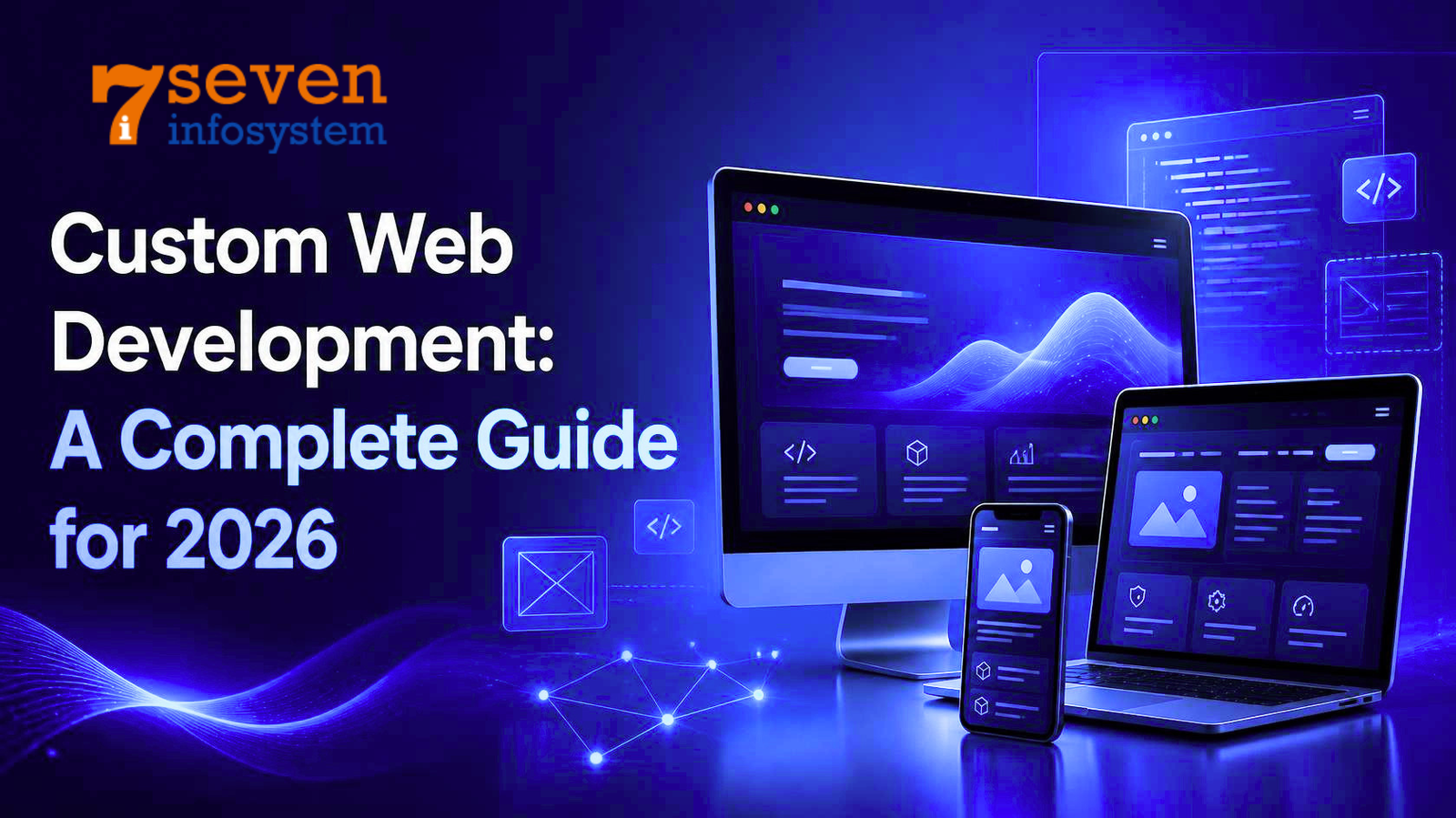
Custom Web Development: A Complete Guide for 2026
Learn how custom web development helps businesses in 2026 with tailored websites, modern technologies, better user experiences, and scalable solutions.
Introduction
A business website is usually the place people look to find out about a company, check out what it does and decide if it's worth reaching out to. Just having a website is not enough anymore. People want it to load quickly, work smoothly, have content be easy to use on phones and be safe for them to use. Meeting these needs is more than making it look nice; it is about creating a website that is built for real business needs.
This is when custom web development is useful. By using a pre-made theme or a simple website tool companies can make online experiences that fit their goals, how they work, their brand and what people expect. Whether it's a service company that wants leads or a big company that needs a complicated online system a custom website gives more control over what it can do and how it can grow.
What Is Custom Web Development?
Custom web development refers to the procedure in which websites and web applications are designed and developed to meet the needs of the business or organization. In the case of custom web development, it is not necessary for the developers to fit all the needs to an existing template.
For instance, a small service business might need to develop a website where there are pages of services, inquiry forms, request for appointments, and location details. However, in the case of an e-commerce website, they would require filters, inventory management, payment systems, accounts, and order tracking. Both websites are needed, but they have different needs.
Custom Website Development vs. Template-Based Websites
There is an option to build a template-based website in case an individual or a company requires an easy website at once. It usually involves pre-designed templates and standard features, hence, reducing the amount of work that should be done during development.
Custom website development is a way to build a site. The design and features are made specifically for the business of being limited by what a certain template can do.
The main differences include:
Design flexibility: Custom layouts can reflect a brand's identity and customer journey more precisely.
Feature selection: Businesses can prioritise the tools and functions they actually need.
Long-term adaptability: New features can be planned around the website's architecture as requirements evolve.
Integration options: A custom website may be designed to connect with CRM systems, inventory management software, payment services, or internal business tools.
But it is not always true that custom web development is the only correct choice. Sometimes an informational web site can be built perfectly with the help of a proper template.
Why Custom Web Development Matters for Businesses in 2026
Customers interact with businesses across mobile phones, tablets, laptops, search engines, social platforms, and online directories. As a result, a website needs to do more than display company information. It should help visitors understand the offering, find answers, and take the next step with minimal friction.
Custom web development gives businesses an opportunity to put these needs first while building a digital platform which will be able to grow along with them.
1. A Website Built Around Business Goals
All businesses have their own priorities. Some of them require qualified leads, some need an online store, others require an opportunity to make appointments and so on.
At the beginning of a custom project, all such goals are defined and implemented in the website's features. Professional services companies might need pages with descriptions of services, cases and consultations request forms. Distributors may require product catalogues and quotation forms.
When the website structure matches its purpose visitors can move through the customer journey, with ease.
2. A Better User Experience
Visitors are more likely to explore a website when it is easy to understand and navigate. Clear menus, readable content, helpful page layouts, and consistent calls to action all contribute to a better experience.
Custom creation allows groups to arrange pages based on the questions customers often have. By making users go through extra steps developers can build easy paths that let important information be found quickly.
3. Greater Control Over Performance
How fast a website works has an effect on how easy it's to use. Big pictures, code, bad database questions and wrong hosting setup can make pages take too long to load.
A well thought out development project can focus on code, improved files, right caching and the right systems. So performance still depends on regular checking, good hosting, outside services and how the website changes after it is put online.
4. Scalability of the Website When the Business Expands
As the business grows, new services can be added to the website. In some cases, such services as online booking, dashboards, notification, and other languages may become necessary. The scalable website should have a flexible structure that would facilitate implementation of these changes.
The scalable structure does not require creating everything at once; rather, it implies selection of a flexible architecture that meets future needs of the business.
Key Benefits of Custom Web Development
Custom web development offers more than a pretty look. If the project is planned carefully, custom web development can help marketing, customer service, internal operations and long‑term growth.
Brand Identity and Differentiation
A website is a part of how customers see a business. A distinct layout, consistent visual language, useful content and thoughtful interactions can help a company present itself professionally.
Moreover, the custom approach will save the brand from having the same boring page similar to the competitor’s one. The main purpose is not to make pages unusual just because.
Functionality That Matches Daily Operations
Standard website tools might not work for every business process. Custom development allows for features like quotation calculators, booking systems, approval workflows, dashboards based on user roles or links to existing business software.
For instance a company that gets lots of service requests could use a form to gather the information from the start. That information can then go to the team, based on automation rules and system integrations.
Improved Search Engine Readiness
A well-built website can provide a strong technical foundation for SEO. Logical navigation, descriptive URLs, mobile usability, accessible page structures, and appropriate metadata can help search engines understand the site's content.
Good development alone doesn’t mean high rankings. Search visibility also depends on content matching what users are looking for competition levels, backlinks, local relevance and consistent improvements, over time.
Improved Integration with Business Tools
There are many different programs used by business companies for sales, marketing, accounting, communication with customers, and storage of goods. Using certain APIs and taking into consideration security issues, a custom site may integrate specific programs in order to minimize duplication of effort and to streamline information flow.
It is necessary to understand in advance which processes need integration to avoid additional expenses and unnecessary complications.
Types of Custom Web Development Services
Custom web development services could mean many different kinds of projects. It will help businesses understand which category of custom web development suits their needs.
Business Website Development
In business website development, a company is presented, its products and services are described, the credibility of the company is built, and enquiries are attracted. The features usually include the service page, the form for contacting, the team page, testimonials, location and blog posts with useful information.
Such a website is quite suitable for consultants, manufacturers, agencies, and any other business that wants to make an impression on the web.
Development of Custom Web Application
A web application gives more interactive capabilities compared to just an informative website. Login, management of information, completing transactions, task execution can all be done through the browser.
The examples are customer portals, booking websites, online stores, project management systems, and reporting dashboards. They typically require more complicated planning of user permissions, data handling, testing, security.
E-Commerce Website Development
An e-commerce website enables businesses to display products or services and accept online orders. Depending on the requirements, it may include product catalogues, search and filtering, payment gateways, discount rules, shipping calculations, inventory synchronisation, and order management.
A custom solution is needed when the default set of features provided by an e-commerce system does not fit the business model of the company.
Website Modernisation and Maintenance
Not every project needs a brand website. Some businesses want to improve an existing website, update its look, replace technology, boost performance or add new features.
Maintenance is equally important. Security updates, backups, compatibility checks, bug fixes, and performance monitoring help keep a website reliable after launch.
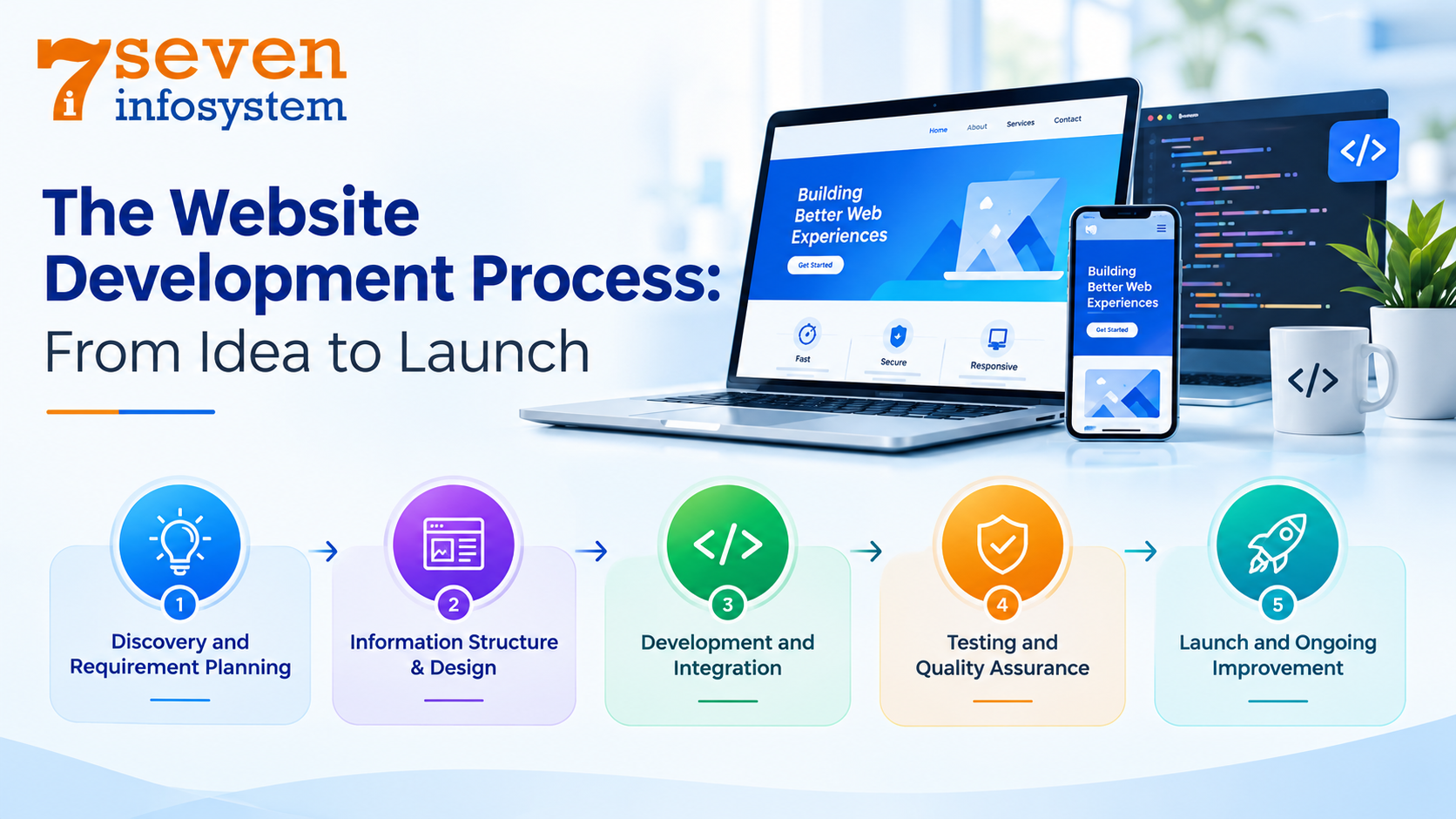
The Website Development Process: From Idea to Launch
A clear website development process reduces uncertainty, helps teams manage costs, and ensures that important requirements are addressed before launch.
Step 1: Discovery and Requirement Planning
The first stage is to understand the business, its audience, its objectives, and its current challenges. In this phase, the team needs to know about the target users, the necessary pages, features, integration, budget and time frame.
It is also helpful to separate must‑have features from improvements.
Step 2: Information Structure & Design
After the requirements are identified, the information architecture is created by the team, which consists of sitemap, navigation, content structure, and user experience paths.
The designers develop wireframes and design concepts that will help to visualize the pages in order to find possible usability problems at the early stage of the project.
Step 3: Development and Integration
We begin development by turning the approved designs into pages and features, for the website. Front‑end developers focus on the parts of the website that visitors see and interact with. Back‑end developers handle the server‑side logic, data processing, authentication and other functions that the website requires. At this stage the website can also integrate third‑party tools and business systems if it is technically feasible and secure enough.
Third-party tools and business systems can also be integrated at this stage, subject to technical feasibility and security considerations.
Step 4: Testing and Quality Assurance
Before launch we test the website across all browsers, screen sizes and devices. We check that links work forms submit navigation is clear loading times are good errors are. Key features behave correctly. We also run security checks, accessibility reviews and user acceptance testing. Every problem we find should be sorted out. Fixed before the website goes live.
Security checks, accessibility reviews, and user acceptance testing are also valuable.
Step 5: Launch and Ongoing Improvement
Launching the website involves setting up hosting, linking the domain, installing analytics, checking redirects and confirming that all essential features work in the environment. This is not the end. We keep watching performance, studying how users behave, updating content, installing security patches and improving the website based on feedback and real results.
However, the process should not end at launch. Businesses should monitor performance, review user behaviour, update content, apply security patches, and improve the site based on genuine feedback and business results.
Web Development Technologies to Know in 2026
Web development technologies decide how a website is created, put together hosted and kept running. The best set of tools to use depends on how complicated the project's how fast the website needs to work, what the developers know, what other systems need to connect and how long the website will stay in use.
Front-End Technologies
Front-end technologies control the visual presentation and interactive elements that users experience. HTML provides page structure, CSS manages styling and layouts, and JavaScript supports interactive behaviour.
Tools and libraries like React, Vue and Angular might be good, for projects that need parts that can be used again or that have complicated things happening on the screen.. For simpler websites a big front-end tool might not be needed.
Back-End Technologies
Back-end technologies handle server-side operations, application rules, database communication, and authentication. Common choices include Node.js, Python-based frameworks, PHP, Java, and .NET.
The selection should reflect the team's experience, the application's needs, security requirements, and available hosting options rather than following trends alone.
Databases and Hosting
Databases are used to store and structure data. For some applications, developers can select different databases such as relational databases, for example, PostgreSQL or MySQL, and so forth.
Hosting may vary from website management services to cloud infrastructure. There are several factors that have to be taken into account while making the choice.
Why Full-Stack Web Development Can Be Useful
In full-stack web development, the person works with front-end as well as back-end components of an application. The full-stack developer will assist with user interfaces, application logic implementation, connecting the database, and integration.
It can be useful if there is a small-scale project that would need to have the whole picture of how different components interact with each other. Also, it can help in better communication within the team members.
However full-stack skills do not replace the need for specialists on projects. Big platforms may need front-end back-end, infrastructure, security, design and quality assurance experts.
The best team structure depends on the project’s scope and risk, not on how many technologies are used.
How to Choose a Custom Web Development Company
Selecting a custom web development company is an important decision because the right partner can shape your website’s architecture, usability, security, and future maintenance.
First, review the company’s portfolio. Look for projects that demonstrate relevant functionality, thoughtful design, and a clear understanding of business requirements. Also, ask how the team handles project discovery, communication, testing, and post-launch support.
Next, clarify ownership and responsibilities before signing a contract. Confirm who will own the source code, design files, domain, hosting accounts, and third-party subscriptions. In addition, ask how the company prices changes, reports progress, and provides support after launch.
A reliable web development company should explain technical decisions in clear language. It should also be transparent about limitations, costs, and possible trade-offs. Finally, be cautious of companies that promise guaranteed search rankings, unrealistic delivery timelines, or unlimited functionality for a fixed price without clearly defining the scope.
Working With an IT Company in Rajkot
For businesses that are located in Gujarat working with an IT company in Rajkot can make meetings, requirement discussions and regular communication easier. Local knowledge can also be helpful when a website needs to show customers, languages, service areas or business practices.
The location should not be the only thing that decides the choice. Check the skills, past experience, way of talking, managing projects, how secure they are and support over time before choosing.
A good first step is to create a short project brief that explains the business goals, the people you want to reach, the time you expect to finish and the amount of money you have. This helps the companies that might work with you to offer a solution.
How Much Does Custom Web Development Cost?
The cost of web development varies from one project to another since it depends on several factors, including how complex the project is and how much work needs to be done. For instance, a small-scale project that involves building a simple site for a business will not cost as much as an advanced platform with such features as customer logins, payment gateway integration, custom dashboards, etc.
In order to handle the budget effectively, the initial cost of building the site should be separated from costs of hosting, registration fees, subscription fees for software products, maintenance, and development of additional features.
It is also wise to start with a viable version and gradually add new features after learning more about user expectations.
Conclusion
Custom website development allows companies to develop websites and applications that suit their needs, expectations of clients and requirements. Whether it is a professional company website or an advanced web application, it all comes down to choosing the best fit in accordance with the necessary functionality, budget and further development plans.
In 2026 businesses need to think more than about looks. They should focus on how easy the website is to use, how well it works on mobile devices, how fast it loads, how safe it is, how ready it is for search engines, how well it connects with other tools and how it is kept up to date over time. A clear development process can help manage all these things without making things too hard.
Before starting any project make sure to understand what the website needs to do, which features are really important and how to know if it is working well. Then pick a development partner who can explain their plan, talk clearly and help the website after it is done. With planning and always looking to get better a website can be a strong and lasting part of a business.
FAQs
1. What is custom web development?
Custom web development is the process of building a website or web application around specific business requirements, user needs, and desired functionality rather than relying entirely on a pre-built template.
2. What are the main benefits of custom web development?
It offers greater design flexibility, tailored functionality, integration options, and control over future improvements. The value depends on how well the solution matches the business's actual needs.
3. How long does it take to develop a custom website?
The timeline depends on the website's size, features, design complexity, integrations, and feedback process. A simple business website may take less time than a custom web application with complex workflows.
4. Is custom web development better than using a template?
Not always. Templates can suit straightforward websites with limited requirements, while custom development is useful when a business needs specialised features, distinctive user journeys, or greater control over functionality.
5. How do I choose the right custom web development company?
Review relevant projects, technical expertise, communication, testing practices, pricing transparency, code ownership, and post-launch support. Choose a partner that understands your business goals and explains its approach clearly.